26. Stokes' Theorem
Let \(S\) be a nice surface in \(\mathbb{R}^3\) with a nice properly oriented boundary, \(\partial S\), and let \(\vec{F}\) be a nice vector field on \(S\). Then \[ \iint_S \vec{\nabla}\times\vec{F}\cdot d\vec{S} =\oint_{\partial S} \vec{F}\cdot d\vec{s} \] Each piece of the boundary of the surface must be traversed counterclockwise as seen from the tip of the normal vector to the surface.
d. Applications
6. Which Surface Integrals Can be Done Using Stokes' Theorem?
Suppose you are asked to compute \(\displaystyle \iint_S \vec F\cdot d\vec{S}\). Can you always use Stokes' Theorem to do this? No! If \(\vec F\) has a vector potential, \(\vec A\), then \(\vec F=\vec\nabla\times\vec A\) and by Stokes' Theorem: \[ \iint_S \vec F\cdot d\vec{S} =\iint_S \vec\nabla\times\vec A\cdot d\vec{S} =\oint_{\partial S} \vec A\cdot d\vec{s} \] However, if \(\vec F\) does not have a vector potential, then you can not use Stokes' Theorem and you must do the integral directly as: \[ \iint_S \vec F\cdot d\vec{S} =\iint_S \vec{F}(\vec R(u,v))\cdot\vec N\,du\,dv \] See the basic definition of the surface integral of a vector. You can check to see if \(\vec F\) has a vector potential by computing its divergence. If \(\vec\nabla\cdot\vec F\ne0\) then \(\vec F\) does not have a vector potential. If \(\vec\nabla\cdot\vec F=0\) then \(\vec F\) probably has a vector potential and definitely does if \(\vec F\) is continuous on all of \(\mathbb R^3\).
Compute the surface integral \(\displaystyle \iint_H \vec{F}\cdot d\vec{S}\) for \(\vec{F}=\langle 2yz,2xz,2xy\rangle\) over the hemisphere \(H\) given by \(z=\sqrt{4-x^2-y^2}\) oriented upward.
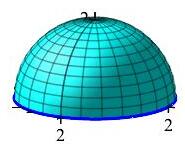
Since \(\vec\nabla\cdot\vec F=0+0+0=0\), \(\vec F\) has a vector potential. We write \(\vec F=\vec\nabla\times\vec A\) and assume \(A_3=0\). So we need to solve \[\begin{aligned} -\partial_z A_2&=F_1=2yz \\ \partial_z A_1&=F_2=2xz \\ \partial_x A_2-\partial_y A_1&=F_3=2xy \\ \end{aligned}\] The first two equations say \(A_2=-yz^2+f(x,y)\) and \(A_1=xz^2+g(x,y)\). Then the third equation says \(\partial_xf-\partial_yg=2xy\). This is satisfied by \(f=x^2y\) and \(g=0\). So \[ \vec A=\langle xz^2,-yz^2+x^2y,0\rangle \] So \[ \iint_H \vec{F}\cdot d\vec{S} =\iint_H \vec\nabla\times\vec A\cdot d\vec{S} =\oint_{\partial H} \vec A\cdot d\vec{s} \] The boundary is the circle \(x^2+y^2=4\) with \(z=0\) traversed counterclockwise. It may be parametrized by \(\vec r=(2\cos\theta,2\sin\theta,0)\) and has velocity \(\vec v=\langle-2\sin\theta,2\cos\theta,0\rangle\). On the curve the vector field is \(\vec A=\langle 0,4\cos^2\theta2\sin\theta,0\rangle\) and its dot product with the velocity is \(\vec A\cdot\vec v=0+4\cos^2\theta2\sin\theta2\cos\theta+0 =16\cos^3\theta\sin\theta\). So the integral is \[ \oint_{\partial H} \vec A\cdot d\vec{s} =\int_0^{2\pi} 16\cos^3\theta\sin\theta\,d\theta =\left[\rule{0pt}{10pt}-4\cos^4\theta\right]_0^{2\pi}=0 \]
Compute the surface integral \(\displaystyle \iint_H \vec{F}\cdot d\vec{S}\) for \(\vec{F}=\langle 2xz,2yz,2z^2\rangle\) over the hemisphere \(H\) given by \(z=\sqrt{4-x^2-y^2}\) oriented upward.
Since \(\vec\nabla\cdot\vec F=2z+2z+4z\ne0\), \(\vec F\) does not have a vector potential and we need to compute the surface integral directly. The hemisphere may be parametrized in spherical coordinates as: \[ \vec R(\phi,\theta)=\langle2\sin\phi\cos\theta,2\sin\phi\sin\theta,2\cos\phi\rangle \] for \(0\le\phi\le\pi\) and \(0\le\theta\le2\pi\). The normal is: \[\begin{aligned} \vec{N}&=\vec{e}_\phi\times\vec{e}_\theta =\begin{vmatrix} \hat{\imath} & \hat{\jmath} & \hat{k} \\ (2\cos\phi\cos\theta&2\cos\phi\sin\theta&-2\sin\phi) \\ (-2\sin\phi\sin\theta&2\sin\phi\cos\theta&\quad0\quad) \end{vmatrix} \\ &=\langle4\sin^2\phi\cos\theta,4\sin^2\phi\sin\theta,4\sin\phi\cos\phi\rangle \end{aligned}\] Next, we evaluate \(\vec F=\langle 2xz,2yz,2z^2\rangle\) on the surface and compute its dot product with the normal: \[\begin{aligned} \vec F(\vec R(\phi,\theta)) &=\langle 8\sin\phi\cos\phi\cos\theta,8\sin\phi\cos\phi\sin\theta,8\cos^2\phi\rangle \\ \vec F\cdot\vec N &=32\sin^3\phi\cos\phi\cos^2\theta +32\sin^3\phi\cos\phi\sin^2\theta +32\cos^3\phi\sin\phi \\ &=32\sin^3\phi\cos\phi+32\sin\phi\cos^3\phi =32\sin\phi\cos\phi \end{aligned}\] So the integral is: \[\begin{aligned} \iint_H \vec{F}\cdot d\vec{S} &=\int_0^{2\pi}\int_0^{\pi/2} \vec{F}\cdot\vec N\,d\phi\,d\theta \\ &=\int_0^{2\pi}\int_0^{\pi/2} 32\sin\phi\cos\phi\,d\phi\,d\theta \\ &=64\pi\left[\dfrac{\sin^2\phi}{2}\right]_0^{\pi/2} =32\pi \end{aligned}\]
Compute the surface integral \(\displaystyle \iint_D \vec{F}\cdot d\vec{S}\) for \(\vec{F}=\langle xy, yz, 0\rangle\) over the portion of the plane \(z=3-x-y\) above the disk \(x^2+y^2 \le 1\). You can rotate the plot with your mouse.
\(\displaystyle \iint_D \vec{F}\cdot d\vec{S}=-\,\dfrac{\pi}{4}\)
Since \(\vec\nabla\cdot\vec F=y+z \neq 0\), \(\vec F\) does not have a vector potential and we need to compute the surface integral directly. The plane may be parametrized in polar coordinates as: \[ \vec R(r,\theta)=\langle r\cos\theta,r\sin\theta,3 - r\cos\theta - r\sin\theta \rangle \] for \(0\le r \le 1\) and \(0\le\theta\le2\pi\). The normal is: \[\begin{aligned} \vec{N}&=\vec{e}_r\times\vec{e}_\theta =\begin{vmatrix} \hat{\imath} & \hat{\jmath} & \hat{k} \\ (\cos\theta,&\sin\theta,&-\cos\theta - \sin\theta) \\ (-r\sin\theta,&r\cos\theta,&r\sin\theta - r\cos\theta) \\ \end{vmatrix} \\ &=\hat\imath(r\sin^2\theta-r\sin\theta\cos\theta+r\cos^2\theta+r\cos\theta\sin\theta) \\ &\quad-\hat\jmath(r\cos\theta\sin\theta-r\cos^2\theta-r\sin\theta\cos\theta-r\sin^2\theta) \\ &\quad+\hat k(r\cos^2\theta+r\sin^2\theta) \\ &=\langle r,r,r \rangle \end{aligned}\] Next, we evaluate \(\vec F=\langle xy, yz, 0 \rangle\) on the surface and compute its dot product with the normal: \[\begin{aligned} \vec F(\vec R(r,\theta)) &=\langle r^2\sin\theta\cos\theta, 3r\sin\theta - r^2\sin\theta\cos\theta - r^2\sin^2\theta, 0 \rangle \\ \vec F\cdot\vec N &=r^3\sin\theta\cos\theta +3r^2\sin\theta - r^3\sin\theta\cos\theta - r^3\sin^2\theta \\ &=3r^2\sin\theta - r^3\sin^2\theta \end{aligned}\] So the integral is: \[\begin{aligned} \iint_D \vec{F}\cdot d\vec{S} &=\int_0^{2\pi}\int_0^{1} \vec{F}\cdot\vec N\,dr\,d\theta \\ &=\int_0^{2\pi}\int_0^{1} \left(3r^2\sin\theta - r^3\sin^2\theta\right)\,dr\,d\theta \\ &=\int_0^{2\pi}\left[r^3\sin\theta - \dfrac{1}{4}r^4\sin^2\theta\right]_{r=0}^{r=1} \,d\theta \\ &=\int_0^{2\pi}\left(\sin\theta - \dfrac{1}{4}\sin^2\theta\right)\,d\theta \\ &=\int_0^{2\pi} \left(\sin\theta - \dfrac{1}{8}[1-\cos 2\theta]\right)\,d\theta \\ &=\left[-\cos\theta - \dfrac{1}{8}\left(\theta-\dfrac{\sin 2\theta}{2}\right)\right]_{\theta=0}^{\theta=2\pi} \\ &= -1-\dfrac{\pi}{4}+1 = -\,\dfrac{\pi}{4} \end{aligned}\]
Compute the surface integral \(\displaystyle \iint_E \vec{F}\cdot d\vec{S}\) for \(\vec{F}=\langle x, -y, 3x^2 \rangle\) over the upper half of the ellipsoid \(E\) given by \(\dfrac{x^2}{25} + \dfrac{y^2}{16} + \dfrac{z^2}{9}=1\) oriented upward.

\(\displaystyle \iint_E \vec{F}\cdot d\vec{S}=375\pi\)
Since \(\vec\nabla\cdot\vec F=1-1+0=0\), \(\vec F\) has a vector potential. We write \(\vec F=\vec\nabla\times\vec A\) and assume \(A_3=0\). So we need to solve \[\begin{aligned} -\partial_z A_2&=F_1=x \\ \partial_z A_1&=F_2=-y \\ \partial_x A_2-\partial_y A_1&=F_3=3x^2 \\ \end{aligned}\] The first two equations say \(A_2=-xz+f(x,y)\) and \(A_1=-yz+g(x,y)\). Then the third equation says \(-z + \partial_xf+z-\partial_yg=3x^2\). This is satisfied by \(f=x^3\) and \(g=0\). So \[ \vec A=\left\langle -yz, x^3 - xz, 0\right\rangle \] So \[ \iint_E \vec{F}\cdot d\vec{S} =\iint_E \vec\nabla\times\vec A\cdot d\vec{S} =\oint_{\partial E} \vec A\cdot d\vec{s} \] The boundary is the ellipse \(\dfrac{x^2}{25} + \dfrac{y^2}{16}=1\) with \(z=0\) traversed counterclockwise. It may be parametrized by \(\vec r=\langle 5\cos\theta,4\sin\theta,0\rangle\) and has velocity \(\vec v=\langle-5\sin\theta,4\cos\theta,0\rangle\). On the curve the vector field is \(\vec A=\left\langle 0,125\cos^3\theta,0\right\rangle\) and its dot product with the velocity is \(\vec A\cdot\vec v=0+125\cos^3\theta\,4\cos\theta+0 =500\cos^4\theta\). So the integral is \[\begin{aligned} \oint_{\partial E} \vec A\cdot d\vec{s} &=\int_0^{2\pi} 500\cos^4\theta\,d\theta \\ &=500\int_0^{2\pi} \left(\dfrac{1}{2}[1+\cos 2\theta]\right)^2\,d\theta \\ &=125\int_0^{2\pi} (1 + 2\cos 2\theta + \cos^2 2\theta) \,d\theta \\ &=125\int_0^{2\pi} \left(1 + 2\cos 2\theta + \dfrac{1+\cos4\theta}{2}\right)\,d\theta \\ &=125\left[ \theta + \sin 2\theta + \dfrac{1}{2}\left(\theta+\dfrac{\sin4\theta}{4}\right)\right]_{0}^{2\pi} \\ &=125(2\pi+\pi)= 375\pi \end{aligned}\]
Notice that when you can use Stokes' Theorem, the integral is (usually) much easier to compute.
Heading
Placeholder text: Lorem ipsum Lorem ipsum Lorem ipsum Lorem ipsum Lorem ipsum Lorem ipsum Lorem ipsum Lorem ipsum Lorem ipsum Lorem ipsum Lorem ipsum Lorem ipsum Lorem ipsum Lorem ipsum Lorem ipsum Lorem ipsum Lorem ipsum Lorem ipsum Lorem ipsum Lorem ipsum Lorem ipsum Lorem ipsum Lorem ipsum Lorem ipsum Lorem ipsum